
GUIFlow: Temporal Redundancy-Aware Incremental Inference for GUI Agents
Published in arXiv preprint, 2026, 2026
Recommended citation: Ye Li, Haoran Ding, Huanan Liu, Yuan Meng, Yutian Shen, Yuansong Wang, Kangye Ji, Hanyun Cui, Hongbo Duan, Chen Tang, Jiawei Li, Shu-Tao Xia, Zhi Wang. "GUIFlow: Temporal Redundancy-Aware Incremental Inference for GUI Agents." arXiv:2610.34959, 2026. https://arxiv.org/abs/2610.34959
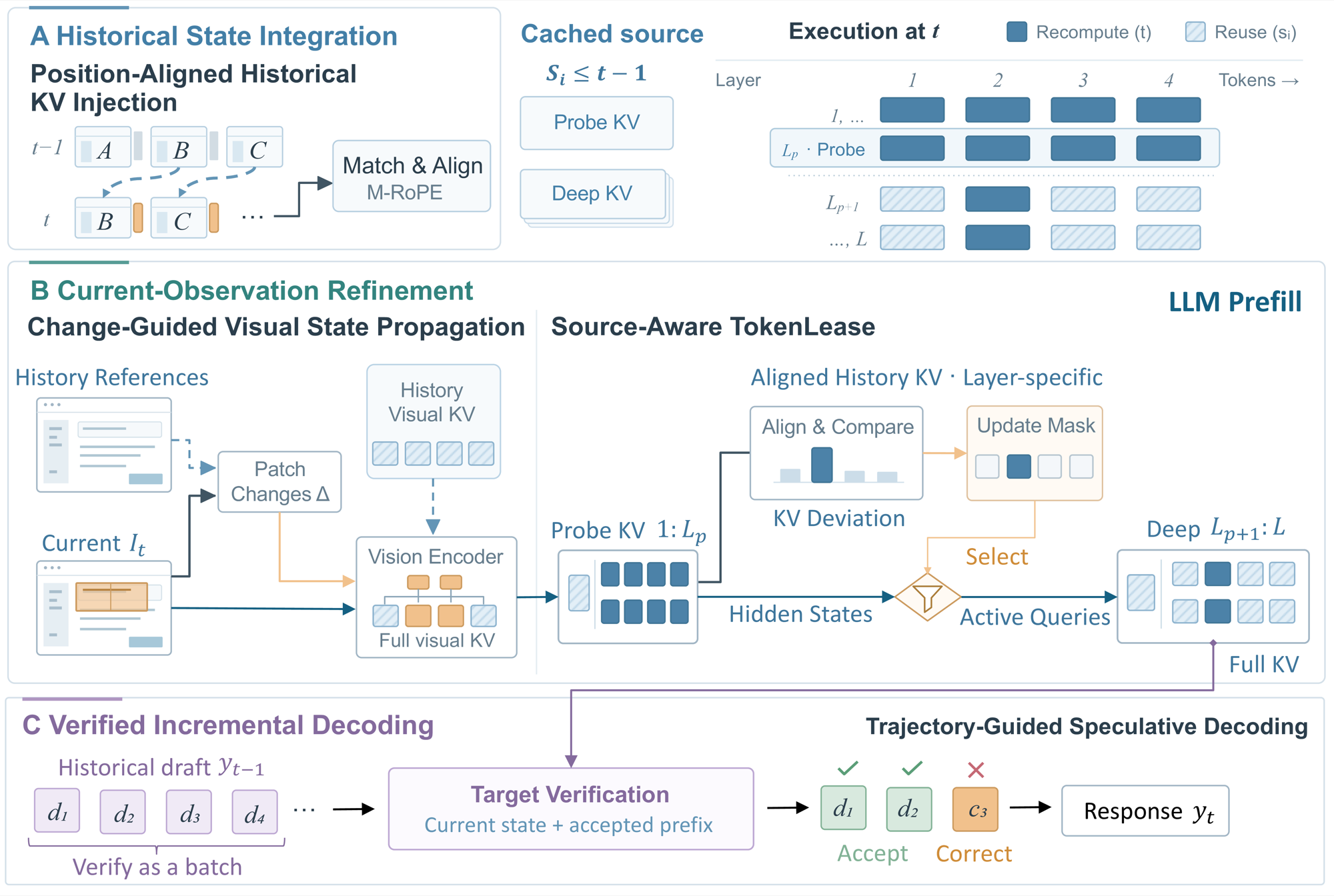
GUI agents built on vision-language models interact with continuously evolving interfaces, yet conventional inference recomputes the representations of largely overlapping observations and histories at every step. This makes multi-step interaction costly, while changes in context, interface content, and action arguments prevent straightforward cache reuse.
GUIFlow is a framework for full-pipeline incremental inference in multi-image GUI interaction. Its central insight is that advancing a decision need not require rebuilding all supporting representations — each step can instead selectively update computational states maintained across the trajectory:
- Position-aligned history reuse. Historical KV states are re-aligned to their new positions and injected into the current context, so past screenshots and turns are not re-encoded.
- Change-guided selective updates. Change signals between consecutive screens decide which current-observation states to refresh in the vision encoder and the language model.
- Self-speculative decoding. Earlier action responses serve as speculative drafts that the target model verifies, accelerating decoding without a separate draft model.
Together, these mechanisms enable cross-step reuse throughout visual encoding, prefill, and decoding — with no additional training, no separate draft model, and no changes to the model-visible inputs or action interface. Across Qwen3-VL, UI-TARS-1.5, and GUI-Owl-1.5, GUIFlow achieves up to 3.39× geometric-mean speedup on offline multi-image benchmarks (AITW, Mind2Web) and up to 3.49× in online, closed-loop interaction on OSWorld, while maintaining task performance broadly comparable to the dense baseline.